

Analogues from 2010s US Fintech
History is a great teacher, just look at the 2010’s fintech boom in the US. I played a part in that boom, joining Earnest in 2014 and helping the company scale from 0 to $1+ billion in student loans in 3.5 years.
When I started, the only provider of student loans was the US Department of Education - who gave everyone the same interest rate. After you graduated, there wasn’t a private financial institution that offered refinancing to reward individuals who had better credit and risk profile. It should’ve been a no-brainer to give the salaried software engineer a better interest rate than their part-time hourly wage earning counterpart.
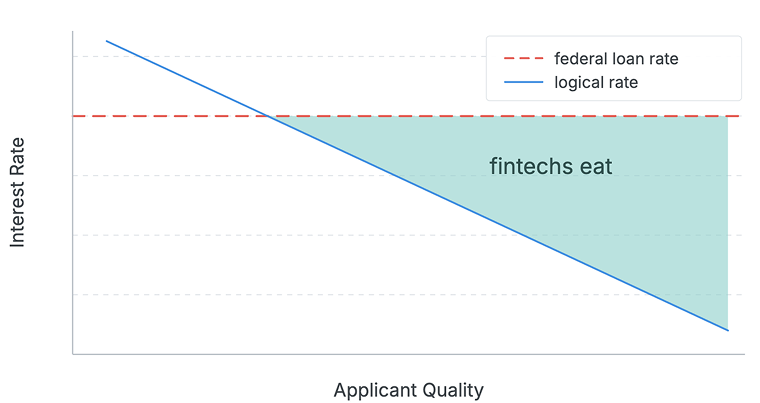
So enter SoFi, Earnest, and a wave of other startups. In those first couple of years, we all ate. Demand was so high that we had our engineers underwriting loans for weeks to get through the backlog of applications. And it wasn’t just student loans; banking, robo-advisors, trading, personal loans all grew massively, capitalizing on convenient internet-first experiences that skipped the in-person appointments and paper applications.
Things are looking rosy, but after a couple years, a new reality hits. For example, at Earnest, we would run an ad campaign targeting a certain demographic looking for student loan refinances. In 2014, it cost us $300 to acquire a customer. Two years later, double. Even with better funnel conversion, we started to run into growth challenges. That’s because as an industry, we had already converted the highest intent users first. Now, we had to work harder to find users who weren’t already customers with us or with competitors. Winning a customer away from SoFi was a lot more expensive than winning a customer from the Department of Education.
This is why fintech is stupid hard. To win, you have to find distribution channels that mitigate CAC escalation. Cash App targeted underbanked communities in the American South that Venmo had ignored, achieving a remarkable $5 CAC through peer-to-peer virality. Chime locked into employer direct deposit programs. Kalshi is using their marketing campaign around March Madness as a $1M acquisition budget (masquerading as a $1B reward) to sign up hundreds of thousands of new users.
You have to implement these acquisition strategies faster than your competition, because the easiest customer you’ll ever acquire is the one no one else has targeted yet. They’re a lot easier than convincing a competitor’s customer to switch.
And scaling doesn’t get easier. It just gets harder. You can’t just 10x your ad spend on a campaign and expect 10x the users; once you scale beyond your most efficient audience segments, each additional dollar reaches less relevant users and delivers lower marginal performance. That’s why Revolut growing their user base 30% off 50M users is 1000x harder than your seed or series A neobank 3x’ing user base from 10k to 30k. Finding an incremental 15M users a year profitably is incredible execution.
The State of Stablecoin Companies Today
The situation today is a fight against both incumbency and saturation.

It’s not the greenfield space of 2023; there are competitors you need to win against now. In the issuance space, you’re already seeing the distribution wedges at work. USDT and USDC command 80% of the $300+ billion stablecoin market cap. USDT is the default unit of account on virtually every offshore exchange, the dominant trading pair in emerging markets from Turkey to Nigeria. USDC locked in Coinbase as its primary distribution partner and became the institutional-grade choice for US-regulated entities.
As for saturation, I think this image sums it up nicely. In reality, there should be more like 100 spidermen pointing fingers at each other. A new neobank springs up daily offering banking services to one or more niche markets, issuing spend cards powered by Rain. New remittance and payments companies spring up offering cheaper and faster money movement between specific customer types in specific country corridors.
Incumbents Are Tougher in 2026
In the 2010s, BigFi consisted of just slumbering financial giants, relatively easy pickings. Unfortunately this time around, you’re going up against the very same 2010s fintechs that made it and a set of savvier institutions.
In 2026, you’re competing with both new-age giants like Coinbase, BitGo, Ramp, Stripe, Revolut, and Circle as well as historical behemoths like Visa, Mastercard, Fidelity, Franklin Templeton, and as of last Friday, Morgan Stanley for a piece of the pie. They don’t have to spend a ton of resources acquiring new users (though they will). They can just add another product to their list of offerings and increase the LTV of their existing customer base. The trend of the 2010s was unbundling specific financial services and making them digitally-native and therefore better. The 2020s is being marked by the great rebundling, as every fintech converges to offering a suite of products across banking, trading, treasury management, payments, and other core financial infrastructure.
Breaking Through with Product and Execution
Even in the face of stiff competition, startups can still vie for market share through differentiated product and GTM execution.
1. Product - Better, Different, Regulated
You can make an existing product 10X+ better, then go for it. If you’re going to build a crypto exchange, be like Pax Markets, which is enabling nanosecond execution latency by compressing the entire orderbook execution onto a single chip, a 1000x improvement compared to existing server-based infrastructure.
You can go after a different product space that no one else is focusing on. Instead of building stablecoin payments for the same G20 corridors, create a product for the exotic corridors that have unique flows desperate to reduce their transaction costs by hundreds of basis points. Build for a future with agents as the primary payers rather than human actors. Figure out what types of use cases actually matter in a world where decisions are driven proactively by probabilistic logic.
You can do the hard work with regulatory regimes globally to get licensed and compliant. If you’re targeting the Nigerian market, then Nigeria's new Investment and Securities Act framework and building relationships with the central bank around cNGN are natural barriers to entry that once crossed, give you a leg up on new entrants. Ditto for the EU's MiCA framework, Singapore's MAS regulations, and the US’s OCC and CFTC.
With these advantages comes better pricing power, enabling your business to own more of the margin stack for the financial service that you offer.
2. Stablecoins have a global but unevenly distributed TAM - use that to your advantage
Stablecoins and blockchain rails mean that you can now offer the same set of services to a global audience. Unlike the 2010s, there are now 150+ jurisdictions that you can serve. And that means that there can be multiple winners across different geographies, corridors, and customer segments. Being strategic about who you choose to court is table stakes.
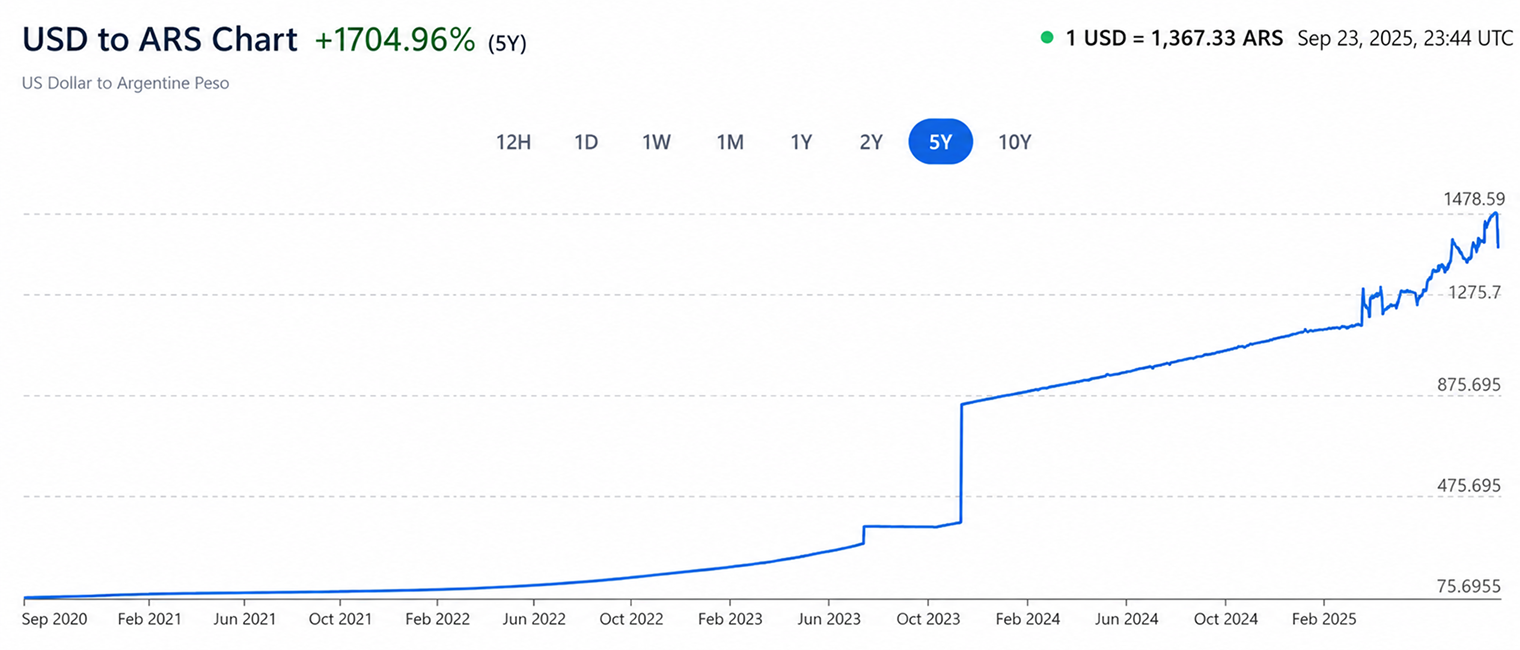
You might decide to go after emerging markets. Demand for dollars in these countries is unabated. After all, an Argentinian holding the US dollar would have a god-tier return profile that would make Buffet, Soros, and Simons envious.
You find that the cost of acquiring a banking customer in Brazil (Nubank - $7) or South Africa (TymeBank - $4.50) is lower, but you also need to understand how much lower the assets/LTV/ARPU are for these demographics as well. Every geography has the potential for great LTV/CAC, but the tactics will look different - sharia compliance in the Middle East, boots on the ground in SE Asia, digital-to-cash local partnerships in Africa.
If your distribution strategy looks like everyone else’s, your outcome will too.
The Right to Win at Scale
The companies that earn the right to win at scale just keep compounding these small edges in product and execution. Over time, those advantages compound into higher usage, better margins, and bigger balance sheets. As your business starts to become legible to capital markets, you can raise debt facilities for better cost of capital. You can raise massive pools of venture capital to keep your acquisition and referral engines humming. You now have a brand name that can compound trust. And before you know it, you’ve now become a giant in the space, competing directly with the largest fintechs and traditional financial institutions for market supremacy. Most stablecoin companies won’t make it. Does yours have what it takes to win at scale?